
Heterostructure electrodes grown directly on molybdenum foil combine high capacitance with ultra-long cycle life in a safe aqueous electrolyte
Supercapacitors deliver high power and long cycle life, but raising their energy density in aqueous systems without sacrificing durability remains a central challenge. Molybdenum oxides and sulphides are promising candidates: MoO₃ offers high redox capacity but suffers from limited conductivity and structural fatigue during cycling, while MoS₂ provides fast, surface-governed charge storage but needs a well-connected conductive backbone to stay stable. Conventional electrodes add a further weak point, as polymer binders introduce resistive interfaces and can lose adhesion during long-term operation.
This study addresses these limitations with a binder-free MoOx/MoS₂ heterostructure grown directly on molybdenum foil. The foil serves simultaneously as the molybdenum source and the current collector, so no binders, conductive additives, or slurry coating are needed at any step.
Key findings
The optimised electrode reaches a specific capacitance of 878.9 F g⁻¹ at 1 A g⁻¹ in a three-electrode configuration, at a practically relevant active mass loading of 3.70 mg cm⁻².
Integrated into an asymmetric supercapacitor with an activated carbon positive electrode and 1 M Na₂SO₄ electrolyte, the device operates over a 1.5 V window and delivers 56.1 F g⁻¹ and 17.5 Wh kg⁻¹, normalised to the total active mass of both electrodes.
After 100 000 continuous cycles, run on a single cell over approximately 150 days without electrolyte refreshing, the device retains more than 97 % of its initial capacitance. Coulombic efficiency remains near unity throughout, and the maximum energy density changes only from 17.5 to 17.2 Wh kg⁻¹.
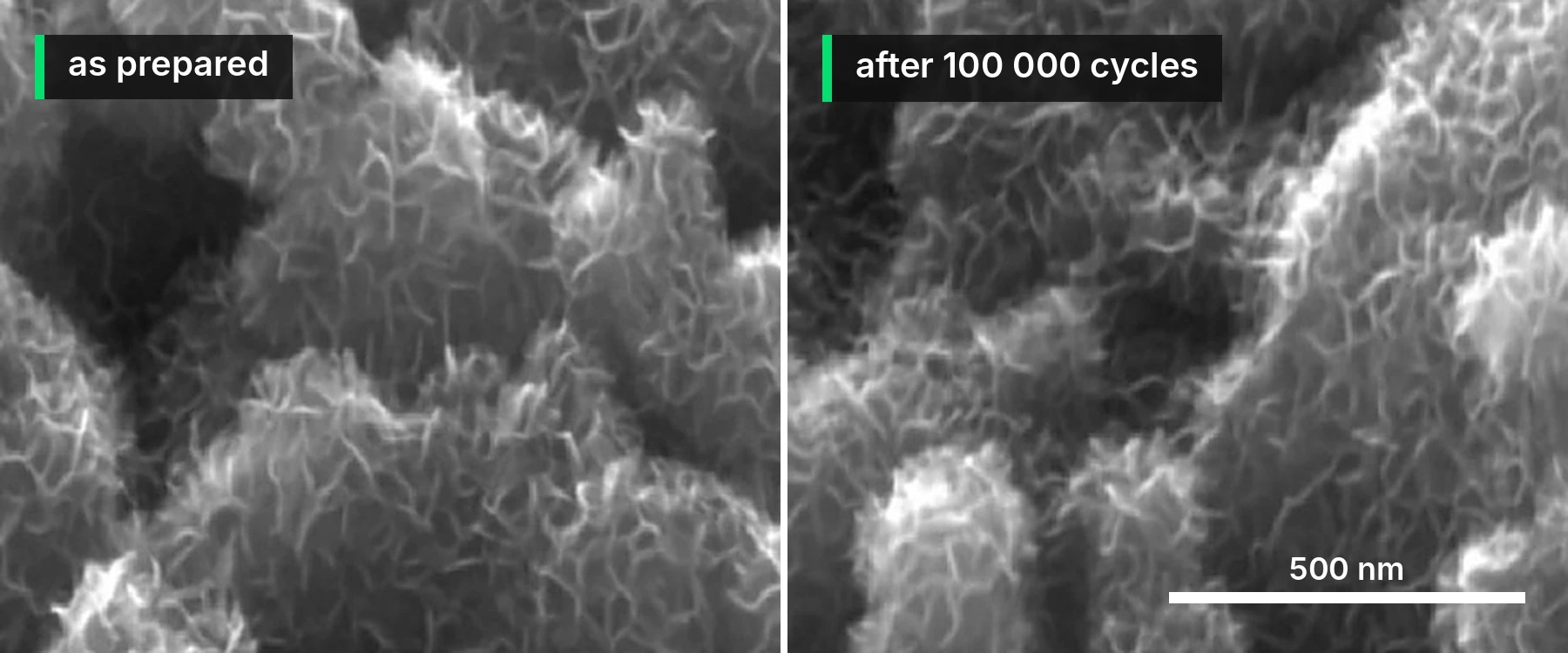
Post-mortem analysis confirms the stability at the material level. Raman modes shift by at most 0.5 cm⁻¹, within the spectral resolution, and SEM shows the MoS₂ nanoflake layer intact, without delamination or coarsening.
Charge storage is dominated by fast surface processes, with a capacitive contribution of 93.5 % at 500 mV s⁻¹.
How each step contributes
The electrode is prepared in four steps: a one-minute activation in KOH, thermal oxidation at 500 °C, hydrothermal sulfurization with thiourea, and the addition of hydrazine as a reducing agent during sulfurization. The study compares five preparation routes designed as a stepwise series, where each route adds one step to the previous one. This makes it possible to quantify the contribution of every step directly.
Chemical activation before oxidation is the decisive step for building an electrochemically accessible oxide scaffold, raising the capacitance by more than an order of magnitude. The sulphide-free oxide scaffold alone delivers 391.5 F g⁻¹. Hydrothermal sulfurization increases this to 524.2 F g⁻¹, and hydrazine-assisted sulfurization to 878.9 F g⁻¹. Hydrazine accelerates the conversion of the oxide surface into MoS₂, producing a dense, continuous layer of nanoflakes instead of sparse deposits. The conformal MoS₂ layer thus more than doubles the capacitance of the scaffold on which it grows.
Why it matters
Because the active layer is grown from the substrate rather than deposited onto it, there is no binder or coating interface that could delaminate during cycling. This explains the combination of high capacitance and durability that is rarely achieved together. Compared with recently reported molybdenum-based supercapacitors, the cycle life exceeds most devices by one to two orders of magnitude at comparable retention.
The neutral aqueous electrolyte is non-flammable, low-cost, and environmentally benign, and the synthesis uses few steps on a metallic current collector. Together, these features make the approach relevant for long-life hybrid energy storage, where safety and service life outweigh maximum energy density.
Research context
The work was carried out within the 2DSuperCap project, which develops hybrid supercapacitor elements based on two-dimensional materials. It builds on the group's earlier optimisation of MoO₃ electrodes through temperature control and KOH activation. Structural characterisation combined SEM, XRD, Raman spectroscopy, and XPS, while electrochemical performance was evaluated by cyclic voltammetry, galvanostatic charge–discharge, and impedance spectroscopy in both half-cell and full-cell configurations.
Publication details
The work, titled "Binder-free MoOx/MoS₂ heterostructures based on molybdenum enabling ultra-stable hybrid supercapacitors," has been published in Journal of Power Sources, Volume 697 (2027).
Authors:
P. Ondrejka, M. Husár, A. Stranovský, A. Petrík, M. Sojková, I. Pis, P. Novák, M. Kemény, M. Mikolášek
Affiliations:
Institute of Electronics and Photonics, Slovak University of Technology in Bratislava Institute of Electrical Engineering, Slovak Academy of Sciences Institute of Nuclear and Physical Engineering, Slovak University of Technology in Bratislava
The research was supported by the EU NextGenerationEU through the Recovery and Resilience Plan for Slovakia under project No. 2DSuperCap-09I05-03-V02-00037, and by grants VEGA 2/0075/25 and VEGA 1/0707/24.