
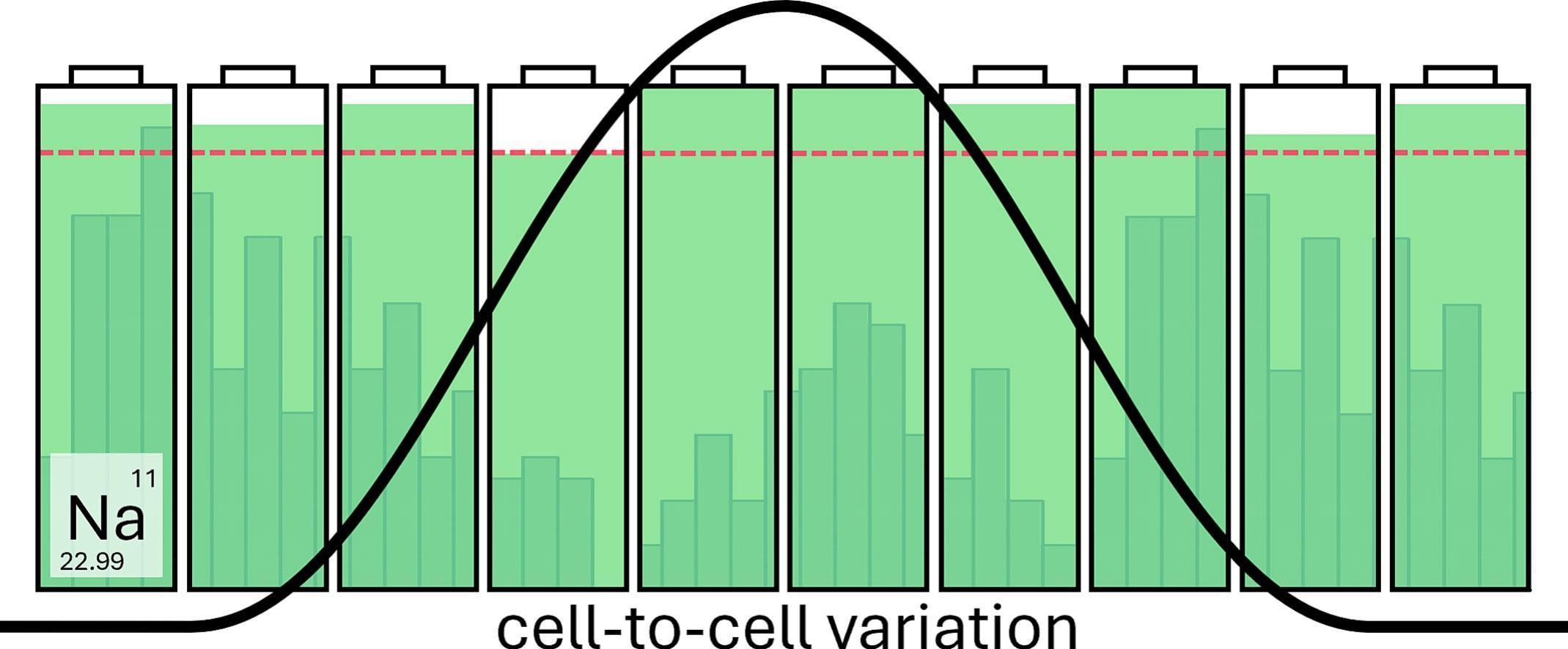
Comprehensive characterization of 100 commercial Na-ion cells establishes baseline for battery system integration
With the first commercial sodium-ion cells entering the battery market and several manufacturers announcing upcoming production, understanding their cell-to-cell variation is becoming essential for safe and reliable deployment in energy storage systems. Despite this importance, no published work has systematically quantified cell-to-cell variation in commercial Na-ion battery cells or assessed how such variation manifests in their electrical and electrochemical characteristics.
A new study from BatteryLab addresses this gap. The work presents a comprehensive characterization of electrical and electrochemical variability in a batch of 100 fresh commercial 18650 Na-ion cells, examining disparities in nominal capacity, open-circuit voltage profiles, electrochemical impedance spectroscopy features, incremental capacity analysis peaks, and internal resistance.
Key findings
The nominal capacity exhibits a coefficient of variation of 2.14%, demonstrating excellent homogeneity that is comparable to, or even surpassing, that of commercial 18650 Li-ion cells. In contrast, EIS features show notably higher variability, which may reflect the novelty and ongoing optimization of current Na-ion manufacturing.
Irregularities in OCV profiles limit the accuracy of state-of-charge estimation, with errors approaching approximately 2% in the low-SOC region, while remaining below approximately 1% at mid- and high-SOC levels. This demonstrates that when evaluating OCV-related error in battery systems, it is crucial to account for disparity not only across the cell population but also across individual SOC regions.
Internal resistance values are comparable to those reported for Li-ion batteries, and IR profiles remain relatively uniform while correlating strongly with nominal capacity (r = −0.87), identifying IR as a promising SOH indicator.
Incremental capacity analysis reveals five peaks, three of which are consistently recognizable across the entire population. These peaks show strong correlations with several key battery parameters, highlighting their diagnostic relevance for future degradation studies.
Implications for battery systems
Cell-to-cell variation inevitably leads to parameter dispersion across battery populations. The most frequently discussed parameters are capacity and internal resistance, as their inhomogeneity can significantly alter system behavior—leading to uneven current distribution, reduced usable capacity, accelerated degradation, and in extreme cases, safety hazards.
However, battery cells may differ in a range of other parameters beyond capacity and resistance. These include subtle alterations in open-circuit voltage curves and disparities in impedance features such as SEI layer resistance or charge-transfer resistance. Since OCV curves are fundamental for SOC assessment and individual EIS parameters serve as inputs to battery models and state estimation algorithms, overlooking such variation can compromise model accuracy.
The present study provides the baseline required for informed experimental design and robust model development. By quantifying expected variability within a nominally identical cell population, researchers can design experiments that explicitly account for manufacturing-induced heterogeneity and develop estimation algorithms that remain robust in the presence of realistic parameter dispersion.
Research context
The studied cells are Hakadi 18650 Na-ion cells with hard carbon negative electrodes and NaxNiyFezMn1 − y − zO₂ (NFM) positive electrodes, rated at 1.5 Ah nominal capacity. The characterization included three formation cycles, GITT measurements for OCV and IR profiling, and galvanostatic EIS over a frequency range of 20 kHz to 10 mHz at 25°C.
Beyond industrial quality control and cell matching, a detailed understanding of cell-to-cell variation in electrochemical descriptors is particularly relevant for the academic community. These characteristics are routinely used as inputs for battery diagnostics, degradation studies, and models, yet their intrinsic dispersion within a nominally identical cell population is rarely quantified. The reported variability should be regarded not merely as a manufacturing artifact, but as an inherent property that must be considered when working with commercial Na-ion battery cells.
Publication details
The work, titled "Comprehensive characterisation of cell to cell variation in commercial sodium ion 18650 battery cells," has been published in Journal of Energy Storage, Volume 158 (2026).
Authors:
M. Kemény, M. Brázda, S.K. Mulpuri, P. Venugopal, M. Mikolášek
Affiliations:
Institute of Electronics and Photonics, Slovak University of Technology in Bratislava
Faculty of Electrical Engineering, Mathematics and Computer Science, University of Twente
The research was supported by grants APVV-21-0231, APVV-22-0132, APVV-24-0321, VEGA 1/0707/24, and the FreeTwinEV project (Grant Agreement No. 101159989) under the Horizon Europe programme.
📄 DOI: 10.1016/j.est.2026.121838